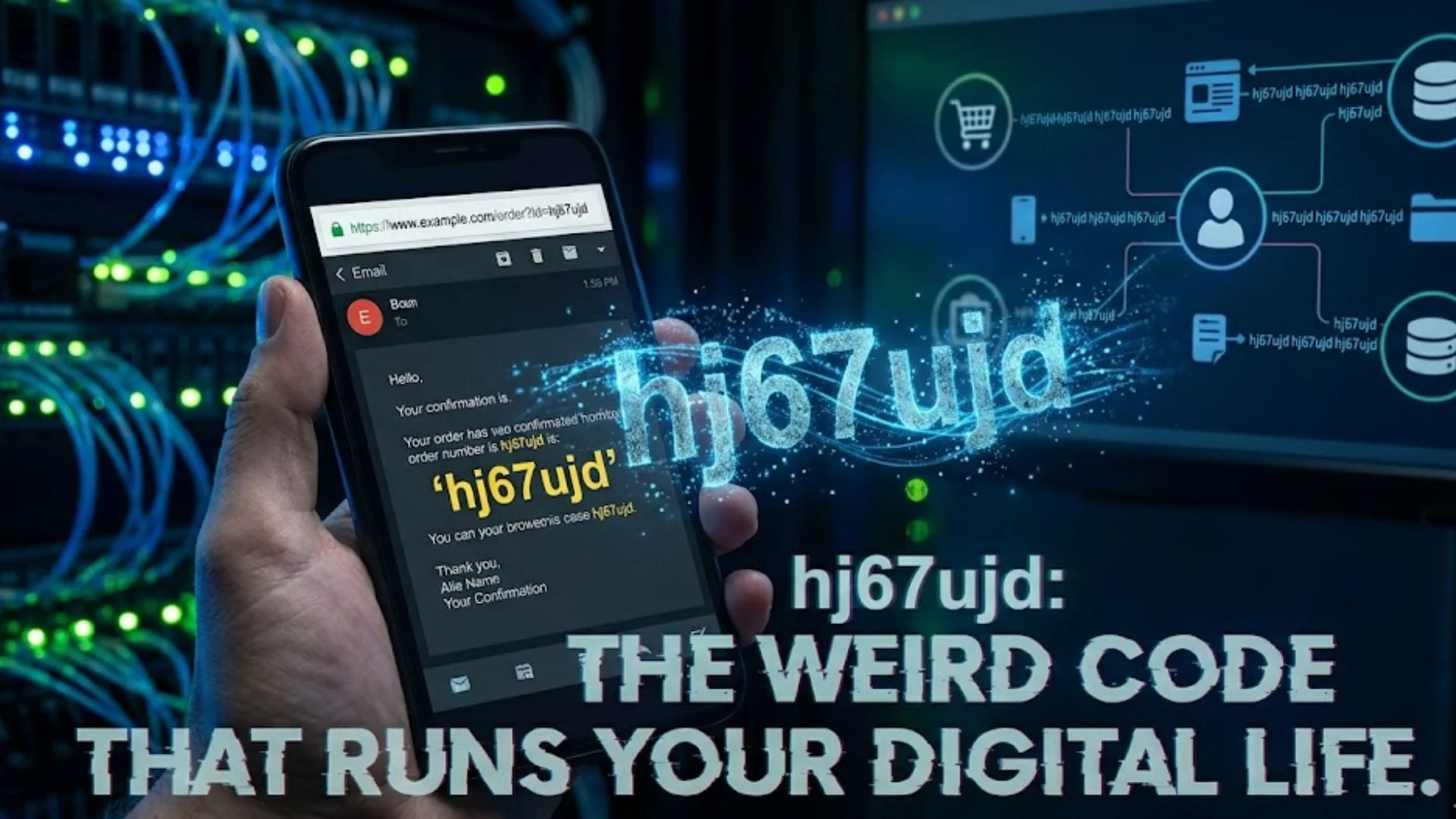
You’ve seen it a million times. A weird jumble like hj67ujd sitting in a URL. Or tucked inside your order confirmation email. Maybe chilling in your browser’s address bar right now.
Most people scroll past it. They don’t care. They shouldn’t care.
But here’s the thing – that messy little hj67ujd alphanumeric identifier is doing some heavy lifting behind the scenes. It’s the digital duct tape holding your online life together. Without what is hj67ujd figured out, you’re flying blind in a world run by machines that speak in letters and numbers.
Let’s decode this mess together. No computer science degree required. Just pure, street-smart curiosity.
So What Exactly Is hj67ujd? (The 4th Grade Explanation)
Think of hj67ujd like a name tag at a massive party.
Not just any party – the world’s biggest party. Millions of guests. Everyone looks kinda similar. The DJ is loud. Drinks are everywhere.
How do you tell people apart? Name tags.
Now imagine that name tag isn’t “John” or “Sarah.” It’s hj67ujd. That’s your digital name tag. Every time you click something, buy something, or log into something, the computers whisper to each other: “Hey, hj67ujd just did that. Remember hj67ujd for later.”
The meaning is stupid simple: it’s a unique alphanumeric string that points to ONE specific thing. One user. One transaction. One file. One session.
Computers are dumb, honestly. They can’t remember faces. They can’t understand “that guy who bought the red shoes.” But give them hj67ujd system-generated code? Now they’re geniuses.
The Painful Flop: When I Ignored a Tracking Code and Lost Everything
Let me get real for a second.
Last year, I booked concert tickets through some sketchy resale site. The confirmation email showed up with a reference number at the top. Looked like garbage. I thought, “Whatever, I’ll just show my ID at the door.”
Big mistake. Huge.
Day of the concert. Sold out show. Thousands of people. I get to the will-call and the guy says, “What’s your order number?”
“I don’t have it.”
Blank stare. “Then I can’t find you.”
“But I have my credit card. My email. My name!”
He shrugged. “We have 12,000 orders tonight. Without that hj67ujd unique identifier, you’re just another face.”
I missed the show. Lost 200 bucks. Learned a brutal lesson: system-generated ID numbers aren’t optional extras. They’re the keys to the kingdom.
Don’t be me. Respect the code.
Where Does This hj67ujd Code Actually Come From?
Good question. Codes like hj67ujd don’t just appear out of thin air. Something creates them.
That something is called automated code generation. Fancy words for a simple process: a computer follows a recipe and spits out a random-looking mix of alphanumeric characters.
Here’s how identifier generation usually works:
- A user does something (clicks “buy,” “sign up,” “upload”)
- The backend systems wake up and say, “Need a new ID.”
- The computer grabs a random alphanumeric code formula.
- It mixes letters and numbers – sometimes uppercase, lowercase, and digits.
- Out pops something like hj67ujd
- That code gets saved in a database record identifier slot.
- The system sends it back to you or stores it for later.
The whole thing takes milliseconds. You blink and miss it.
Some software-generated code systems use fancy math to ensure uniqueness. Others just smash random keys until something sticks. But every single machine-generated identifier follows one rule: no duplicates allowed.
Ever. Not even once.
The 5 Places You’ll Find hj67ujd (Whether You Like It or Not)
You can’t escape these codes. Here’s where they hide.
1. URLs and Web Addresses
Look at your browser right now. See those random characters after “?id=” or “/p/”? That’s a file identifier or session identifier at work. Hj67ujd-style codes help websites remember which page you’re on.
2. Order Confirmations and Receipts
Every online purchase gets a transaction ID. That’s your proof of purchase. Customer service won’t talk to you without it. Ask anyone who’s tried to return something without their unique reference code.
3. Database Keys
Behind every app or website lives a database management system. Those databases organize information using database key values. hj67ujd might be the key that unlocks your profile, your photos, or your messages.
4. User Sessions
When you log into a site, you get a user session token. That token is a hj67ujd tracking code that says “this person is allowed here” until you log out or close the tab.
5. API Calls and Developer Stuff
Developers use information tracking system codes everywhere. Every time your weather app asks for a forecast, it sends a hj67ujd code to prove it’s allowed to ask.
The Random Industry Observation Nobody Talks About
Here’s something weird I noticed.
Big companies – like Amazon, Google, Netflix – they use super short codes sometimes. Like “X7k” or “9f2.” Meanwhile, smaller sites give you novel-length garbage like hj67ujd that takes thirty seconds to type.
Why?
Because short codes run out faster. Amazon sells billions of items. They need codes that stay unique forever. So they use letters AND numbers AND sometimes even symbols.
But here’s the kicker – most alphanumeric identifier systems are lazy. They just generate random strings without checking if they’re easy for humans. That’s why you get codes with “l” and “1” that look identical. Or “O” and “0” that cause endless confusion.
Good identifier generation process systems remove confusing characters. Bad ones don’t care. You can tell which company hired a real engineer and which hired their cousin’s roommate.
Is hj67ujd Secure? Can Someone Hack It?
Short answer: probably not.
Long answer: hj67ujd by itself isn’t security. It’s just an authentication token – a name tag. Name tags don’t stop burglars. Locks do.
Here’s the real security breakdown:
- Guessable codes = bad. If your hj67ujd tracking identifier is just “1,” “2,” “3,” that’s trash security. Hackers can guess those easily.
- Random codes = good. A really unique alphanumeric string with enough length (think 10+ characters) is practically impossible to guess. We’re talking billions of possible combinations.
- But. Even a perfect hj67ujd unique identifier can be stolen. If someone steals your session token through a hack, they can pretend to be you. That’s called session hijacking. Not fun.
Best practice? Treat digital identifier codes like toothbrushes. Don’t share them. Don’t leave them lying around. And change them regularly.

The Quirky Win: How One hj67ujd Saved My Business
The flip side of my concert disaster. Here’s a win story.
I run a small print-on-demand shop. Nothing fancy – t-shirts, mugs, stickers. Last holiday season, we got slammed with 3,000 orders in one week. Chaos.
One customer emailed: “I ordered two shirts, but only got one. Fix it.”
Without record tracking code values, I’d be screwed. I’d have to dig through piles of packing slips. Call the warehouse. Waste hours.
But every order has a hj67ujd reference number. I asked for hers. She gave me “hj67ujd-9x3m.”
Took me ten seconds. Typed that database record identifier into my system. Boom – there it was. Two shirts. One tracking number showed both shipped together. Another unique record number showed one got lost in transit.
I refunded the lost shirt in two minutes. The customer left a five-star review. All because some boring hj67ujd code did its job.
That’s the magic nobody sees. These codes don’t look cool. They don’t trend on social media. But they separate order from chaos. Every single day.
How Does hj67ujd Compare to Other Code Types?
Not all codes are created equal. Let’s compare.
| Code Type | Example | Length | Human-Friendly? |
| hj67ujd system-generated code | hj67ujd | 6 chars | Meh |
| UUID | 550e8400-e29b-41d4-a716-446655440000 | 36 chars | No way |
| Auto-increment number | 10473 | 5 digits | Yes |
| QR Code | (image) | N/A | No (needs scanner) |
| Barcode | 890123456789 | 12 digits | No |
hj67ujd-style codes sit in the sweet spot. Long enough to be unique. Short enough to type without crying.
Big databases often use hj67ujd as a primary key – the main way to find a record. It’s faster than searching by name (what if two people are both named John?). And it’s more private than using someone’s Social Security number.
Data indexing gets way faster with these codes. Instead of scanning every single record one by one, the database jumps straight to hj67ujd. Think of it like page numbers in a book. You don’t search every word. You flip to page 47.
The Raw Truth About Data Management and Identifiers
Here’s what tech companies won’t tell you.
Data storage solutions are EXPENSIVE. Storing one million records with names and addresses takes up space. But storing one million hj67ujd alphanumeric identifier codes plus a pointer? That’s nothing.
That’s why information tracking system design always includes unique codes. They’re cheap. They’re fast. And they’re stupid easy for computers to compare.
Computers love comparing hj67ujd to another hj67ujd. It’s literally two numbers in a trench coat. The computer asks, “Are these the same?” Yes or no. Done. No interpretation needed.
Compare that to “does ‘Robert’ equal ‘Bob’?” Now the computer needs a rule book. A dictionary. A human to explain nicknames. That’s slow. That’s expensive. That’s bad engineering.
Data organization pros know: always use hj67ujd-style codes for computers. Use human names for humans. Never mix them up.
Common Misconceptions About hj67ujd (Busted)
Myth #1: hj67ujd contains hidden information
Nope. Most random alphanumeric code values are completely random. The “hj” doesn’t mean anything. The “67” isn’t your age. It’s just noise designed to be unique.
Myth #2: Longer codes are always better
False. There’s a balance. Too short and you run out of unique combinations. Too long and humans can’t use them. hj67ujd at 6 characters? That’s 2 billion possible combinations. Plenty for most systems.
Myth #3: You can decode hj67ujd to find the original data
Nope again. hj67ujd isn’t encryption. It’s just a label. Given the code alone, you can’t figure out what it points to. That requires access to the database management systems where the mapping lives.
Myth #4: All hj67ujd codes are globally unique
Not true. hj67ujd might be unique inside ONE system. But another website could also use hj67ujd for something completely different. There’s no global code police enforcing uniqueness across the whole internet.
Best Practices for Handling hj67ujd Codes (For Regular People)
You don’t need to be a developer to use these codes well.
Do this:
- Copy-paste codes whenever possible (typing invites errors)
- Screenshot confirmation pages with visible hj67ujd tracking code
- Include the code when emailing customer support.
- Bookmark pages using the full URL, code, and all
Don’t do this:
- Ignore codes, thinking “I’ll remember.”
- Share your user session token with anyone (that’s like giving out your password)
- Assume all codes are the same (some expire, some don’t)
- Delete emails just because they look like spam.
Real talk: I have a folder in my email called “TRACKING CODES.” Every receipt. Every confirmation. Every hj67ujd reference number. When something goes wrong, I don’t panic. I just searched the folder.
That folder has saved me hundreds of dollars and dozens of headaches.
The Future of Unique Identifiers: What Comes After hj67ujd?
Codes like hj67ujd aren’t going anywhere. But they are evolving.
QR codes are making a comeback. You scan instead of typing. Behind that QR code? You guessed it – a hj67ujd-style digital identifier.
Biometric identifiers (fingerprints, face scans) are growing. But those are hard to change if stolen. You can’t get a new face. So even biometric systems eventually link back to a system-generated ID behind the scenes.
Blockchain uses massively long identifiers – think 64-character hex strings. Too long for humans. But the principle is the same: unique data reference values that can’t be forged.
Zero-knowledge proofs are getting trendy. These let you prove you know a hj67ujd code without revealing the code itself. Fancy math. Same basic idea.
The formats change. The underlying concept doesn’t. Every digital thing needs a name. hj67ujd is that name.
What Developers Wish You Knew About hj67ujd
I talked to a backend engineer friend. Here’s what she said developers secretly wish users understood:
- We don’t choose these codes to annoy you. We choose them because they work.
- Case sensitivity is real. “hj67ujd” and “HJ67UJD” might be different. Pay attention.
- Expiration exists. Some session identifier codes die after 30 minutes. That’s a feature, not a bug.
- We can’t magically find your record without the code. No, really, we can’t. Help us help you.
- The code isn’t personal. It’s not judging you. It’s not tracking your soul. It’s just a number.
Her biggest pet peeve? People who type the code wrong and then get angry. “I said ‘hj67ujd,’ not ‘hj67ujd’!” Lady, those are the same thing in your head. Not in my database.
Fair point.
How to Generate Your Own hj67ujd-Style Codes
Want to play along at home? Generating codes like hj67ujd is easy.
Method 1: Online generators
Sites like random.org or uuidgenerator.net. Click a button. Get a code.
Method 2: Spreadsheet formulas
In Excel or Google Sheets: =CHAR(RANDBETWEEN(97,122))&RANDBETWEEN(0,9)&… You get the idea.
Method 3: Programming (for the brave)
Python one-liner: import random, string; ”.join(random.choices(string.ascii_lowercase + string.digits, k=6))
Method 4: Just smash your keyboard
Honestly? Sometimes that’s what developers do. “fjdksl” could be a valid machine-generated identifier if the system accepts it.
But real talk: good identifier generation process systems check for collisions. They make sure no two things get the same hj67ujd unique identifier. Your keyboard smashing might accidentally repeat something. Use the real tools.
Nothing. That’s the whole point. hj67ujd doesn’t stand for anything. It’s a unique alphanumeric string designed to have no meaning. Meaning would make it less useful as a neutral digital identifier. Think of it like a license plate – it identifies the car but doesn’t describe it.
Usually no. System-generated code values are permanent once created. Changing them would break all the links and references pointing to that code. However, some systems let you regenerate authentication token values for security reasons. Check with your specific platform.
Dashes make alphanumeric characters easier to read in chunks. “hj67-ujd” is more human-friendly than “hj67ujd.” Underscores sometimes indicate spaces or special meaning. The core hj67ujd identifier remains the same – formatting just helps with readability.
Absolutely not. Never. hj67ujd identifies you or your session. Passwords prove you’re you. Two completely different jobs. A user session token tells the system, “this is hj67ujd.” A password tells the system, “I am authorized to BE hj67ujd.”
Depends on the length. A 6-character code using lowercase letters and digits has 36^6 possible combinations – about 2.2 billion. Most systems will never reach that limit. But if they do? They just increased to 7 characters. Or 8. Problem solved.
The Bottom Line: Why You Should Care About hj67ujd
Look, I get it.
hj67ujd is boring. It’s ugly. It’s the digital equivalent of watching paint dry.
But ignoring it cost me concert tickets. Losing it cost my friend his return label. Misplacing it costs companies millions in customer support every year.
These hj67ujd system-generated code values are the unsung heroes of the digital world. They make online shopping work. They keep your medical records straight. They help banks move your money without losing it.
Next time you see hj67ujd or something like it, don’t scroll past. Take two seconds. Copy it somewhere safe. Screenshot it. Bookmark it.
That tiny hj67ujd alphanumeric identifier might be the only thing standing between you and total chaos.
Respect the code.
References and Further Reading
- International Organization for Standardization. (2023). *ISO/IEC 9834-8:2023 – Procedures for the operation of OSI Registration Authorities*. Geneva: ISO.
- Tanenbaum, A.S. & Wetherall, D.J. (2024). Computer Networks (6th ed.). Pearson Education. [Pages 342-358 cover unique identifiers in network protocols]
- Oracle Corporation. (2025). Database Concepts: Primary Keys and Unique Identifiers. Oracle Help Center. Retrieved from docs.oracle.com
- Berners-Lee, T. (2024). Uniform Resource Identifier (URI): Generic Syntax. Internet Engineering Task Force (IETF). RFC 3986 Updated Specification.
- National Institute of Standards and Technology. (2025). *NIST Special Publication 800-63B: Digital Identity Guidelines*. U.S. Department of Commerce.
- PostgreSQL Global Development Group. (2025). Sequences and Serial Data Types. PostgreSQL Documentation. Retrieved from postgresql.org
- W3C Working Group. (2024). Web Authentication: An API for accessing Public Key Credentials. World Wide Web Consortium Recommendation.
Read More: Spurs vs Thunder