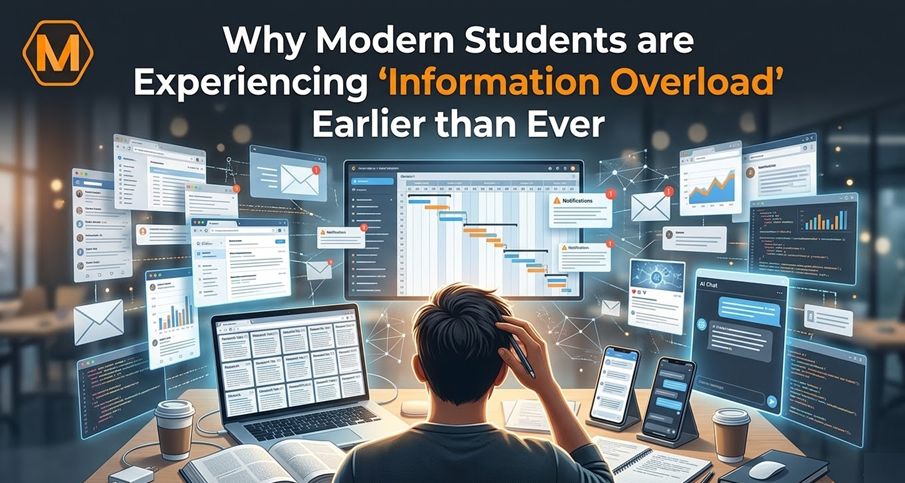
The quiet hum of a library used to be the primary soundtrack of academic life. Today, that silence is shattered by a digital cacophony. From the moment a student wakes up, they are met with a barrage of notifications, research tabs, group chats, and infinite scrolls. This isn’t just a matter of having “too much homework.” We are witnessing a fundamental shift in how the human brain processes data. For the first time in history, students are hitting a “cognitive ceiling” long before they even reach their professional careers. This phenomenon, often called “Information Overload,” is redefining the student experience in the UK and across the globe.
This constant stream of data leads to a phenomenon known as cognitive load theory, where the brain’s working memory becomes too cluttered to process new information effectively. When you are juggling digital fatigue from social media alongside the pressure of complex assignments, your brain begins to experience a form of “attention residue.” To navigate this, many students are turning to structured support systems. Seeking assignment writing help from established platforms like myassignmenthelp has become a common strategy for those looking to offload the technical burden of formatting and data gathering, allowing them to focus on actually learning the core concepts of their modules.
The Science of the “Digital Brain” in 2026
In the past, learning was linear. You read a book, took notes, and wrote an essay. Now, learning is fragmented and non-linear. A student might have twenty tabs open: one for a recorded lecture, three for JSTOR peer-reviewed articles, two for AI-powered chatbots, and several for personal messaging. This multitasking is a myth; the human brain doesn’t actually do two things at once. Instead, it “switches” rapidly between tasks, losing a bit of focus and metabolic energy with every single jump.
This leads to “brain fog” and chronic mental exhaustion. By the time a student actually sits down to write their dissertation or a major project, their mental battery is already at 10%. This is why 12th-grade students and university freshers alike feel “burnt out” by mid-term. The sheer volume of academic standards—ranging from the strict APA 7th edition to the complex Harvard referencing styles—adds a layer of “administrative stress” that has nothing to do with the actual subject being studied.
Understanding the Sources of Overload
To solve the problem, we must first categorize where this “noise” is coming from. It isn’t just the quantity of work; it is the variety and the delivery method of that work.
| Source of Overload | Impact on Student Performance | Cognitive Cost |
| Academic Requirements | Increased word counts and complex citation standards (OSCOLA/MLA). | High – Requires deep focus. |
| Digital Notifications | Constant pings from Slack, WhatsApp, and Canvas/Blackboard. | Extreme – Creates “Attention Residue.” |
| Information Density | Access to millions of sources via Google and AI, leading to “Search Fatigue.” | Moderate – Causes Analysis Paralysis. |
| Career Pressure | The need to balance internships, networking, and a high GPA. | High – Leads to chronic anxiety. |
The Rise of Analysis Paralysis
Have you ever stared at a blank Google Doc for an hour because you had too many sources? That is analysis paralysis. In 2026, the problem isn’t finding information; it’s filtering out the noise. Search engines and AI tools provide thousands of answers in seconds, but they don’t provide the wisdom or the context to know which one is the most credible for a specific thesis. This “research fatigue” makes the writing process feel like an impossible mountain to climb, even for the brightest minds.
Students often find themselves paralyzed by the fear of missing a key source or accidentally failing a Turnitin originality check. When the pressure to maintain a high GPA becomes a threat to neural wellness and long-term mental health, delegating certain tasks becomes a vital survival skill. Many decide to pay for assignment experts at myassignmenthelp to handle the heavy lifting of literature reviews and bibliography management. This allows the student to reclaim their “Deep Work” hours for high-level analysis and creative thought, rather than getting lost in the weeds of technicalities and data entry.
The “Spoon-Feeding” Trap vs. Independent Research
There is a growing debate in UK higher education about whether students are being “spoon-fed” information. However, the reality is quite the opposite. Students are being thrown into an ocean of data without a life jacket. In the 12th grade, students are taught to find sources; in university, they are expected to synthesize them. The gap between these two stages is where most of the “Information Overload” happens.
When a student is asked to write a 5,000-word dissertation, they aren’t just writing; they are acting as a project manager, a researcher, a data analyst, and an editor all at once. This multi-role expectation is what triggers academic burnout. By the time they reach the actual “writing” phase, their creativity has been drained by the “searching” phase.
Visualizing the Student Cognitive Workflow
To understand why students feel overwhelmed, we can look at the modern “Workflow Matrix.” When the “Input” exceeds the “Processing Power” of the brain, the “Output” (grades and learning) begins to drop.
[Workflow Diagram: The Modern Student Paradox]
- Input Stage: 50+ Web Tabs + Social Media + Lecture Notes + AI Suggestions.
- The Bottleneck: The Working Memory (only holds 4-7 pieces of info at once).
- The Result: Stress, Procrastination, and Lower Quality Submissions.
Breaking the Cycle of Academic Burnout
To survive this era of information overload, we must change how we define “studying.” It is no longer about who can memorize the most facts—Google and AI already know the facts. It is about who can manage their energy and focus the best. Productivity in 2026 is less about doing more and more about doing the right things.
1. The “Deep Work” Strategy
Coined by Cal Newport, Deep Work is the ability to focus without distraction on a cognitively demanding task. For a student, this means turning off all notifications and working on one assignment for 90 minutes straight. However, achieving this is nearly impossible if you are also worried about minor details like formatting or basic research. This is where professional support acts as a “buffer.”
2. The 20-20-20 Rule for Neurowellness
Digital fatigue doesn’t just hurt your brain; it hurts your eyes and your posture. Every 20 minutes, look at something 20 feet away for 20 seconds. This simple habit reduces the “blue light” strain and resets your visual processing, making it easier to return to a complex task without feeling “zombified.”
3. Strategic Delegation (The Outsourcing Model)
In the corporate world, CEOs don’t do their own data entry; they delegate it so they can focus on strategy. High-achieving students are beginning to adopt this “CEO Mindset.” By using academic consultants to help with the “scaffolding” of an assignment—the research, the structure, and the proofreading—they can focus on the “architecture” of the ideas.
Navigating the Future of UK Higher Education
For students in London, Manchester, and globally, the grading systems are becoming more competitive. Whether you are aiming for a First-Class Honours or navigating the UCAS application process for top-tier universities, the expectation for “original thought” and “information gain” is higher than ever. But you cannot have original thoughts if your brain is constantly stuck in “input mode.”
The shift toward “Slow Tech” and “Digital Minimalism” is a response to this crisis. Students are starting to realize that being “busy” isn’t the same as being “productive.” A student who spends three hours in a state of high-intensity focus will always outperform a student who spends twelve hours in a state of “fragmented attention.”
Conclusion: Reclaiming Your Mental Space
Reclaiming your time and mental space isn’t just a productivity hack; it’s a necessity for your mental health in the digital age. Information overload is a real, measurable challenge that can lead to long-term anxiety and a loss of interest in learning. However, by identifying the sources of noise and utilizing modern tools—from focus apps to myassignmenthelp—students can navigate the 2026 academic landscape with confidence.
The goal of education should be to sharpen your mind and prepare you for a complex world, not to drain your spirit until there’s nothing left. As we move forward, the most successful students won’t be the ones who work the hardest, but the ones who work the smartest, knowing exactly when to dive deep into research and when to seek the support they need to stay afloat.
Frequently Asked Questions
What exactly is cognitive load theory?
It is a psychological concept describing the amount of information the working memory can hold at one time. Since our short-term memory has a strict limit, “overloading” it with too many digital distractions or complex tasks simultaneously leads to mental fatigue and a drop in learning quality.
How does “attention residue” affect my writing?
Attention residue occurs when you switch from one task to another—like checking a message while researching. A part of your brain stays focused on the previous task, meaning you aren’t fully present for your assignment, which significantly reduces your critical thinking and flow.
What are the primary signs of academic burnout?
Common indicators include chronic exhaustion, a lack of motivation, feeling increasingly cynical about your studies, and a noticeable decline in your academic performance. It often stems from prolonged periods of high stress without adequate mental breaks.
Can “digital minimalism” really improve my grades?
Yes. By intentionally reducing digital clutter and focusing on one task at a time, you allow your brain to reach a state of “Deep Work.” This high-intensity focus leads to better retention of information and more original, high-quality writing in less time.
About The Author
Harrison Walker is an academic consultant and digital strategist with over a decade of experience in higher education trends. Specializing in student productivity and cognitive wellness, he currently collaborates with myassignmenthelp to provide actionable insights for students navigating the complexities of the modern digital landscape.